In heavy commercial trucks operating under severe loading cycles across Africa, Latin America, and Central Asia, the suspension leaf spring pack (front steer axle and rear tandem bogie) supports vehicle gross weight while isolating the chassis frame from road shock. Choosing between parabolic tapered few-leaf springs (2 to 4 leaves) and traditional semi-elliptical multi-leaf packs (9 to 12 leaves) dictates ride comfort, tare weight savings, and resistance against sudden fatigue fractures under unpaved mining overload conditions.
1. Technical Comparison: Parabolic Few-Leaf vs. Traditional Multi-Leaf Packs
Inter-leaf friction dynamics, weight savings, and load stress distributions across suspension types:
| Engineering Parameter | Parabolic Tapered Few-Leaf Springs | Traditional Multi-Leaf Spring Pack |
|---|---|---|
| Leaf Blade Count | 2, 3, or 4 tapered leaves per spring pack | 9, 10, or 12 constant-thickness stacked leaves |
| Leaf Profile Geometry | Parabolic variable thickness (Thick center, tapered ends) | Uniform thickness along entire length of each leaf |
| Inter-Leaf Friction & Contact | Contact only at center clamp and tip rubber pads (Zero inter-leaf friction) | Full-face metal-to-metal rubbing between all adjacent spring leaves |
| Ride Comfort & Shock Absorption | Superior elastic compliance; smooth passenger-car-like ride quality | Stiff and harsh; high internal friction transmits road shock when empty |
| Tare Weight Impact (Front Axle Pair) | approx. 70 – 90 kg (Saves 30% to 40% spring weight) | approx. 130 – 160 kg (Heavy solid steel stack) |
| Overload Tolerance | Moderate overload capability (Risk of sudden brittle fracture if overloaded) | Extreme overload endurance (Leaves support each other progressively) |
| Failure Mode If Broken | Snapping one leaf drops suspension by 30% to 50% immediately | Snapping one leaf allows truck to continue driving safely to repair depot |
| Primary Vehicle Application | Long-haul 4x2 and 6x4 highway tractor heads, tankers, buses | Severe 6x4 and 8x4 mining dump trucks, heavy equipment lowboys |

2. Kinematic Advantages of Parabolic Tapered Technology
For modern long-distance logistics fleets, parabolic springs deliver tangible operating advantages:
- Eliminating Inter-Leaf Rust & Friction Binding: In traditional multi-leaf packs, rust and grit enter between the leaves, binding them together into a solid unyielding block. Parabolic leaves touch only at their tips through composite rubber/nylon spacers, eliminating inter-leaf friction and preserving silky smooth suspension travel for hundreds of thousands of kilometers.
- Significant Front-End Weight Savings: On a highway tractor head, replacing 10-leaf front springs with 3-leaf parabolics saves approximately 120 kg of front axle tare weight, improving steering agility and reducing driver physical fatigue.
- Reduced Tire Cupping & Scalloping: Consistent tire-to-road contact pressure reduces irregular front steer tire scalloping wear, extending steer tire tread life by over 20%.
3. Why Heavy Mining Tippers Demand Traditional Multi-Leaf Packs
In deep open-pit quarries and rough logging tracks, traditional multi-leaf springs remain irreplaceable:
- Progressive Multi-Stage Load Support: As heavy excavator buckets dump 40 tons of blasted stone into the body, the shorter auxiliary helper leaves engage progressively. If an extreme shock load cracks a single spring leaf, the remaining 9 leaves hold the axle securely in place, preventing the axle from shifting and tearing brake air lines.
- High Roll Stiffness in Turns: The heavy friction between stacked leaves provides natural mechanical dampening, preventing excessive lateral cab roll when cornering with high-center-of-gravity loads on banked quarry ramps.
4. Root Causes of Broken Leaf Springs & U-Bolt Torque Protocols
Over 80% of premature leaf spring fractures result from loose suspension U-bolts:
- Center Bolt Shearing: If U-bolts lose clamping torque, the leaves slide back and forth during braking, shearing the central locating pin and throwing the axle out of square alignment.
- Fractures at the Clamping Edge: When U-bolts loosen, the bending moment shifts from the center clamp to the outer edge of the spring seat, causing fatigue cracks to propagate directly through the main leaf at the U-bolt radius.
- Critical U-Bolt Retorque Schedule:
- Tighten Grade 10.9 high-tensile U-bolts in a crosswise diagonal sequence to factory torque: M24 U-bolts to 650 – 750 N·m; M27 mining U-bolts to 850 – 950 N·m.
- Mandatory 500 km Retorque: All new leaf springs settle after initial road running. Retorque all U-bolt nuts after the first 500 km of loaded operation, and check torque every 10,000 km thereafter.
Frequently Asked Questions
Q: Can a truck equipped with broken leaf springs continue driving?
A: If the top main leaf (master leaf with the eye bushing) is broken, the truck must NOT be driven, as the axle can detach and spin backward. If an intermediate secondary leaf is cracked, the truck may be driven at reduced speed (< 30 km/h) directly to the repair shop.
Q: What steel grade is used in genuine Sinotruk and Shacman leaf springs?
A: Genuine OEM spring packs are forged from heat-treated 60Si2Mn or 50CrVA alloy spring steel, shot-peened on the tension surface to induce compressive residual stress that resists fatigue cracking.
Q: Where can fleet operators source genuine heavy truck leaf springs and U-bolts?
A: Browse our complete suspension catalog in the Heavy-Duty Spare Parts Category, inspect original Commercial Heavy Trucks, or consult our International FAQ Center.
Request Leaf Spring & Suspension Parts Catalog
Recommended Semi-Trailers
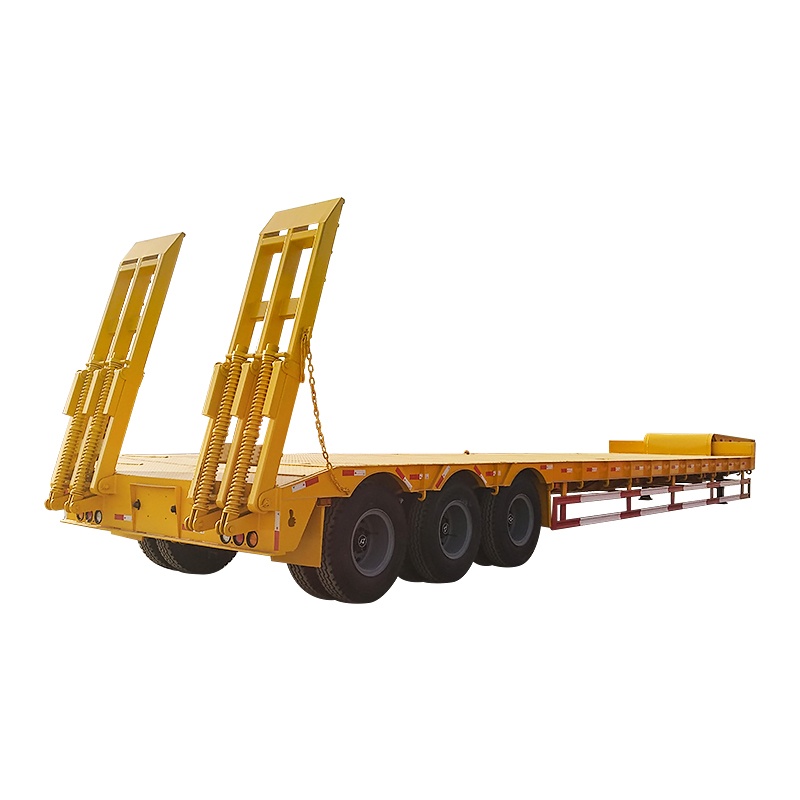 3 Axle Lowbed Semi Trailer | 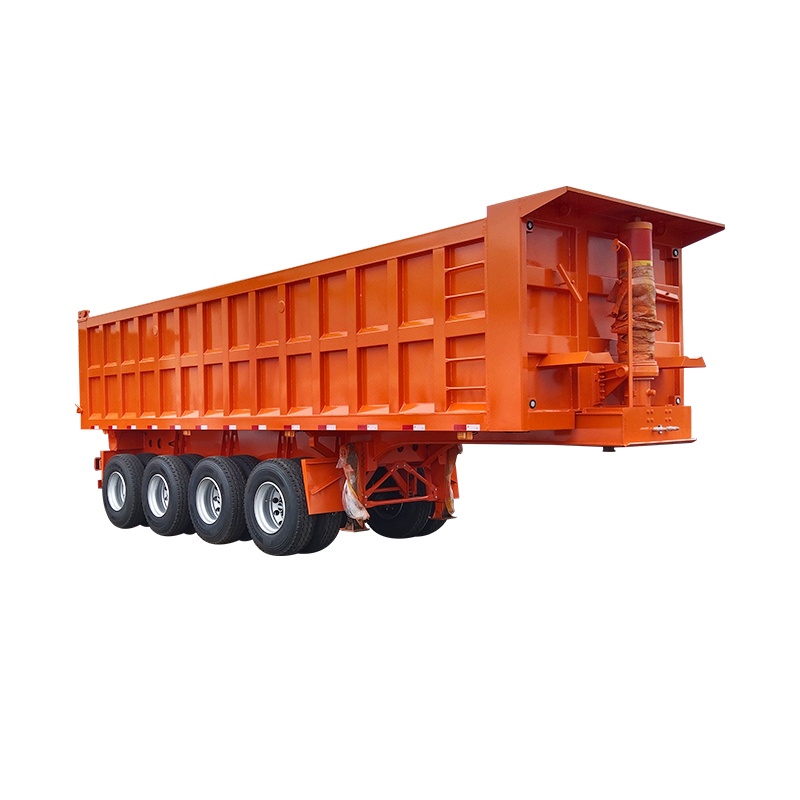 4 Axle Dump Trailer |  3 Axle Flatbed Trailer |