When loading 40 to 80-ton crawler excavators, bulldozers, and drilling rigs onto a heavy-duty lowbed (lowboy) semi-trailer, the rear hydraulic climbing ramps and self-contained 24V DC electro-hydraulic power pack eliminate the severe physical strain and safety hazards of manual spring-assisted ramps. Utilizing dual double-acting hydraulic lift cylinders and integrated mechanical safety lockout pins, hydraulic ramps deploy in under 60 seconds from in-cab or wander-lead pendant controls, providing a stable 12 to 15-degree incline for wide tracked machinery.

1. Technical Specification Comparison: Manual Spring Ramps vs. Electro-Hydraulic Ramps
Lifting capacities, deployment speeds, and operator safety across lowbed loading ramp systems:
| Engineering Parameter | Manual Spring-Assisted Loading Ramps | Self-Contained Electro-Hydraulic Ramps (24V DC Pack) |
|---|---|---|
| Ramp Deployment Method | Physical human manual pulling; spring coil tension assists lifting | Hydraulic cylinders powered by push-button wander-lead pendant |
| Deployment Time per Pair | approx. 3 to 5 minutes of strenuous manual labor | approx. 45 to 60 seconds effortless hydraulic deployment |
| Maximum Ramp Structural Capacity | approx. 30 – 40 Tons concentrated crawler track loading | approx. 60 – 100 Tons heavy crawler impact rating |
| Hydraulic Power Source | N/A | Independent 24V DC electric motor (2.2 kW – 3.0 kW) + mini gear pump |
| Power Supply Integration | N/A | Direct electrical connection to tractor 24V battery via NATO socket |
| Hydraulic Cylinder Type | N/A | Dual heavy double-acting hydraulic cylinders with integrated check valves |
| Working Hydraulic Pressure | N/A | 16.0 – 19.0 MPa (Factory adjustable relief: 21 MPa max) |
| Operator Safety Profile | High injury risk: Springs snap; ramps bounce back during deployment | Maximum safety: Operator stands safely 5 meters away with remote wand |
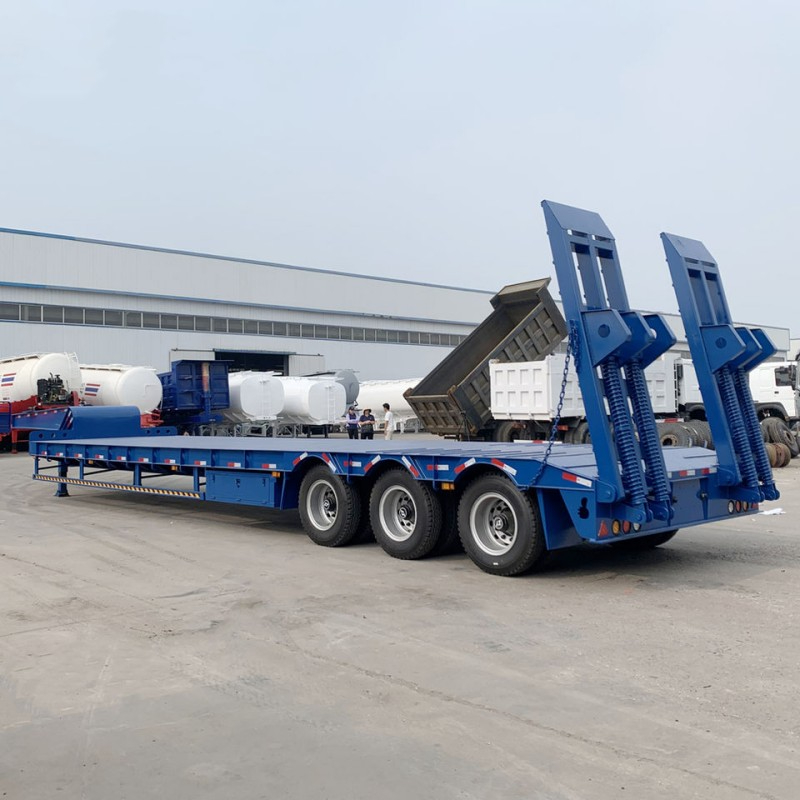
2. The Electro-Hydraulic Circuit: 24V DC Motor & Flow Control Kinematics
The compact power pack mounts inside a lockable weather-sealed steel enclosure on the trailer gooseneck:
- The 24V High-Torque DC Motor: Powered by the tractor's dual 12V batteries (wired in series for 24V) through heavy 35mm² copper cables. When the operator pushes the "Down" button, a heavy-duty solenoid starter switch energizes the motor, driving an internal micro-gear pump.
- Double-Acting Hydraulic Cylinder Control: Hydraulic oil flows through a 4-way 3-position electromagnetic directional spool valve, pressurizing the base end of the ramp cylinders to lift, or the rod end to pull the heavy steel ramps down against ground level.
- One-Way Restrictor (Flow Control) Valves: Heavy steel ramps falling too rapidly will smash onto concrete pavement, warping hinges. Flow control throttle valves restrict return oil flow, ensuring ramps lower smoothly at a steady, controlled rate of 50mm per second.

3. Troubleshooting Common Hydraulic Ramp Malfunctions in Field Operations
Ramp stalling, slow lifting, and hydraulic fluid leaks trace to distinct electrical and mechanical faults:
| Observed Ramp Malfunction | Most Probable Root Cause | Immediate Corrective Action |
|---|---|---|
| Motor clicks rapidly but fails to spin (Ramps won't lift) | Low tractor battery voltage (< 21V); corroded electrical terminal connections; faulty solenoid starter switch | Charge tractor batteries; clean electrical terminals with wire brush; jump solenoid terminals to test starter |
| Ramps lower smoothly but fail to lift back up to travel position | Hydraulic relief valve set too low; internal gear pump worn; low hydraulic oil level in power pack reservoir | Check fluid sight glass; top up with ISO VG 46 hydraulic oil; adjust relief valve screw clockwise to 18 MPa |
| Ramps drop down immediately when pendant button is released | Internal check valve cone contaminated with grit; leaking cylinder piston seal allowing fluid bypass | Disassemble and clean directional valve check cone; replace cylinder internal polyurethane piston seals |
| Ramps twist unevenly during elevation (One side rises faster) | Unequal hose lengths or clogged throttle restrictor valve on one hydraulic lift branch | Clean adjustable flow divider throttle valve; balance hydraulic line flow to equalize cylinder speeds |
4. Mechanical Safety Lockout Pins: Preventing Highway Ramp Drop
Relying solely on hydraulic pressure to hold 2-ton steel ramps upright during 80 km/h highway transit is a lethal hazard:
- The Hydraulic Failure Hazard: If a hydraulic hose rubs through against a sharp chassis flange on the road, line pressure drops to zero. Unsecured ramps will crash onto the highway, vaulting following passenger vehicles.
- Heavy Forged Lockout Pins: Once ramps are fully elevated into the vertical travel position, the driver must insert heavy forged steel locking pins through the reinforced chassis brackets and secure them with spring lynch-pins.
- Secondary Safety Chains: Heavy Grade 80 safety chains with tensioning binders wrap around both ramps, providing secondary positive mechanical retention.
Frequently Asked Questions
Q: What type of hydraulic oil should be used in the 24V power pack?
A: In standard tropical climates, use ISO VG 46 anti-wear hydraulic oil. In extreme cold plateau environments (such as high-altitude mining in the Andes), use low-viscosity ISO VG 32 to prevent motor overload.
Q: Can the hydraulic ramps be powered directly by the truck's engine PTO instead of a 24V electric motor?
A: Yes. Chengda provides optional dual-plumbed hydraulic configurations, allowing operators to run ramps either via tractor PTO hydraulic lines or the self-contained 24V electric power pack.
Q: Where can heavy haulage fleets order custom lowbed trailers with hydraulic ramps?
A: Browse our complete heavy-haul inventory in the Semi-Trailers Category, view our Heavy Lowboy Trailers, or consult our International FAQ Center.
Request Lowbed Trailer Drawings & Hydraulic Ramp Quotation
Recommended Semi-Trailers
 Howo 8x4 Dump Truck |  3 Axle Lowbed Semi Trailer |  3 Axle Lowboy Trailer |