On heavy commercial 3-axle end-dump semi-trailers hauling aggregate, sand, and mining bauxite, the rear overhang dimension (the distance from the centerline of the rearmost axle to the rear pivot hinge pin) dictates tipping stability, tail-chute discharge clearance, and ground-strike prevention. Designing an optimal rear overhang (typically 1,150mm to 1,450mm) paired with a calculated rear pivot height (1,400mm to 1,550mm) prevents the rear chassis tail bumper from bottoming out on the ground at a steep 48-degree dump angle while maintaining legal axle load distribution under highway bridge formulas.
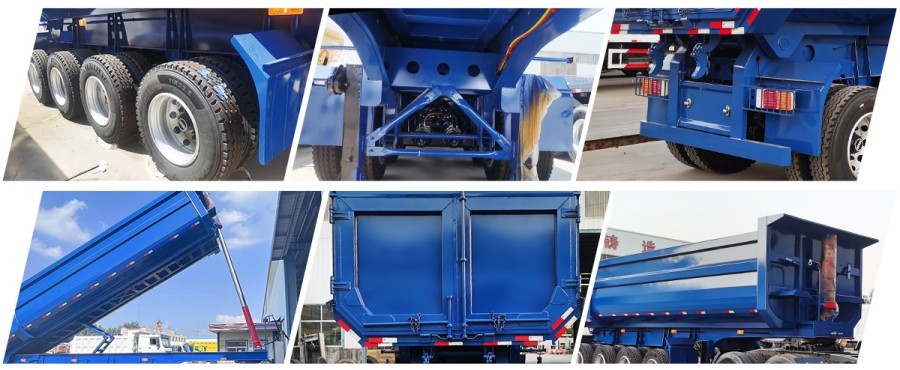
1. Technical Specification Comparison: Short Overhang vs. Long Overhang Dump Trailers
Overhang dimensions, departure angles, tipping stability, and asphalt paver clearances across dump trailer designs:
| Engineering Parameter | Short Rear Overhang Design (Mining Spec: 1,100mm – 1,250mm) | Long Rear Overhang Design (Asphalt / Paver Spec: 1,500mm – 1,750mm) |
|---|---|---|
| Rear Overhang Dimension ($L_{RO}$) | 1,100 mm – 1,250 mm (Compact rear profile) | 1,500 mm – 1,750 mm (Extended rear tail) |
| Departure Angle (Unladen) | Steep 26° to 30° unladen departure angle | Shallow 16° to 20° departure angle (Risk of dragging on steep ramps) |
| Ground Clearance at Maximum 48° Tilt | approx. 450 mm – 600 mm tail bumper clearance off ground | Tight 150 mm – 250 mm (Risk of tail striking unpaved ground) |
| Dynamic Tipping Rollover Resistance | Maximum stability; center of gravity shifts minimal distance rearward | Lower stability; long overhang shifts center of mass far behind rear axle |
| Asphalt Paver Hopper Interface | Requires fold-up rear under-ride bar; tighter paver push-roller gap | Seamless direct discharge directly into road paver receiving hoppers |
| Rear Pivot Hinge Pin Diameter | 80 mm – 90 mm induction-hardened forged steel pin | 75 mm – 80 mm forged alloy steel pivot pin |
| Tire Clearance During Discharge | Discharged rock piles closer to rearmost tires (May require pulling forward) | Material discharges 500mm further behind tires, preventing tire burial |
| Optimal Fleet Application | Open-cast bauxite & iron ore mines, rugged unpaved spoil dumps | Highway asphalt paving, municipal aggregate delivery, gravel stockpiles |
2. The Geometry of 48-Degree Elevation: Preventing Tail-to-Ground Striking
When an 8.8-meter dump body elevates to full 48-degree dump stroke, geometry changes radically:
- The Tail-Strike Phenomenon: As the front multi-stage hoist cylinder extends, the rear lower corner of the dump body swings downward and backward in an arc centered on the main pivot pin. If the rear overhang is excessively long or the pivot pin sits too low, the bottom rear edge of the body or the steel under-ride bumper will dig violently into the ground before reaching full tipping angle.
- The Trapped Hydraulic Pressure Hazard: If the tail strikes the ground while the HYVA cylinder is still pumping at 20 MPa, the immense lifting thrust attempts to jack the rear trailer axles off the ground. This bends the main trailer chassis I-beams, blows cylinder seals, or triggers an instant rollover.
- The Minimum 350mm Clearance Rule: Chengda engineers calibrate pivot hinge placement so that when the body reaches its maximum 48-degree dump angle with tires sitting on soft dirt, the lowest point of the tailgate apron maintains at least 350 mm to 450 mm of vertical clearance above ground level.
3. Lateral Stability Physics: How Overhang Governs Rollover Risk
Over 80% of dump trailer rollovers occur during the final 10 degrees of elevation:
- The Shifting Center of Gravity: As the body rises, the center of gravity moves upward to 7 meters high and shifts rearward toward the pivot hinge. In a long-overhang trailer, this shifts the entire 40-ton cargo mass far behind the rear bogie.
- Loss of Suspension Equalization: With heavy mass hanging behind the rear pivot, the front axle of the 3-axle trailer bogie completely unloads and lifts off the ground. The entire trailer becomes balanced precariously on a single rear axle. If one side of the dumping pad settles by just 50mm, the vehicle tips over laterally in under two seconds.
- The Short Overhang Mining Advantage: A compact 1,200mm overhang keeps the center of mass positioned squarely over the robust 3-axle bogie, maintaining equal tire contact pressure and maximum lateral stability on unpaved African mining spoil tips.
4. Pneumatic Fold-Up Rear Under-Ride Guard (Bumper)
Legal highway safety bumpers create interference during aggregate discharge:
- Automated Pneumatic Elevation: Highway regulations legally mandate a heavy steel rear under-ride protection bumper (maximum 550mm off the ground). However, during asphalt dumping, this rigid bar would smash into the road paver.
- Interlocked Auto-Folding Bumper: Chengda equips export dump trailers with an automated pneumatic folding under-ride bar. When the operator triggers the cab hoist control, pneumatic cylinders automatically fold the rear bumper upward and forward into the chassis frame, clearing pavers and gravel piles completely.
Frequently Asked Questions
Q: What is the optimal rear pivot pin height above ground level for a mining dump trailer?
A: The engineered standard is 1,450 mm to 1,550 mm (unladen on 12.00R20 tires). This provides sufficient height for high-volume rock discharge while keeping the vehicle center of gravity low during highway transit.
Q: How does rear overhang affect tractor fifth wheel loading?
A: A longer rear overhang shifts cargo weight rearward, reducing fifth wheel pin weight on the tractor drive axles. If too long, the tractor drive tires lose traction on slippery construction ramps.
Q: Where can fleet operators procure custom-engineered 3-axle end dump semi-trailers?
A: Browse our heavy commercial vehicle lineup in the Semi-Trailers Category, view original Heavy Mining Dump Semi-Trailers, or consult our International FAQ Center.
Request Dump Trailer Engineering Drawings & Custom Quotation
Recommended Semi-Trailers
 End Dump Semi Trailer | 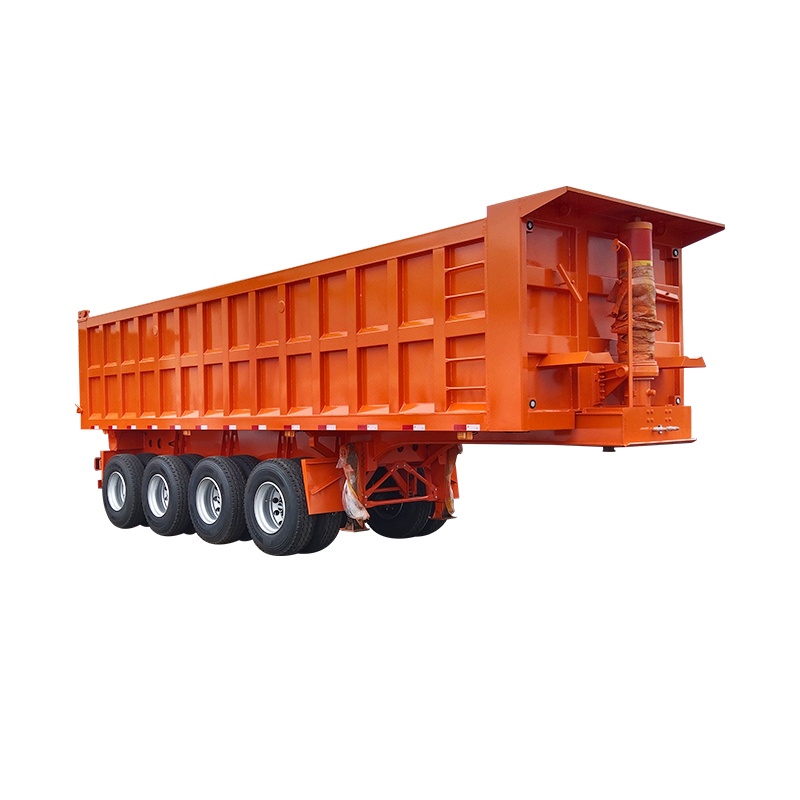 4 Axle Dump Trailer |  3 Axle Flatbed Trailer |