In heavy-haul logistics and mining equipment relocation—transporting 40-to-120 ton crawler excavators, drilling rigs, wheeled loaders, and industrial transformers—choosing between a Removable Gooseneck (RGN) Trailer and a Fixed Gooseneck Lowbed Trailer represents a fundamental engineering decision. While rear-loading fixed gooseneck trailers provide a cost-effective platform for standard wheeled machines, front-loading hydraulic RGN trailers lower loading approach angles to under 6 degrees, eliminate rear ramp rollover risks, and deliver ultra-low travel deck heights (500 mm to 700 mm) to clear strict overhead highway bridge limits.
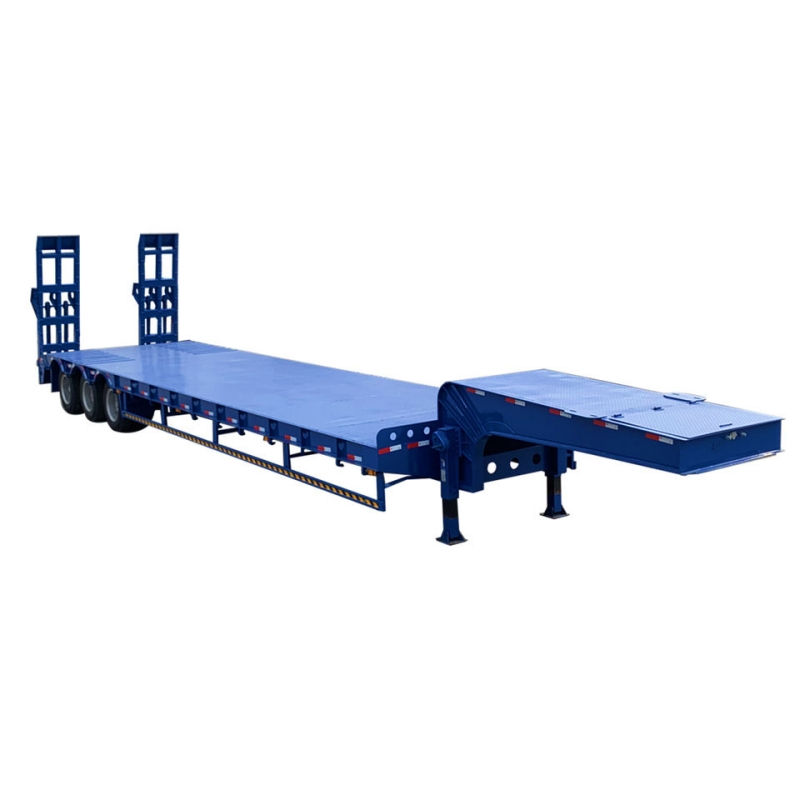
1. Structural Mechanics: Front Loading RGN vs Rear Loading Lowbed
The loading direction and mechanical decoupling design dictate operator safety, equipment wear, and site adaptability:
| Engineering Characteristic | Hydraulic Detachable RGN Trailer | Fixed Gooseneck Lowbed Trailer | Operational Benefit in Heavy Haul |
|---|---|---|---|
| Loading Method | Front Loading: Gooseneck detaches; deck drops flat to ground | Rear Loading: Climbs rear spring or hydraulic ramps over wheels | RGN allows heavy tracked machines to drive on flat ground without climbing steep ramps |
| Loading Approach Angle | Gentle: 4° to 6° | Steep: 14° to 22° | Prevents machinery undercarriage scraping, high-centering, and track slippage |
| Deck Height from Ground | Ultra-Low: 500 mm - 700 mm | Standard Low: 850 mm - 1,050 mm | RGN gains 250 mm to 400 mm of additional vertical height clearance under highway bridges |
| Payload Capacity Envelope | 60 to 120+ Metric Tons (Modular axle lines) | 30 to 70 Metric Tons | RGN accommodates mega mining excavators (50T–90T) and heavy crushers |
| Hydraulic Power Source | On-board diesel power pack or tractor PTO | Manual spring-assist or electric hydraulic ramps | RGN hydraulic cylinders lift and lock deck to road travel height in under 3 minutes |
2. Axle Groupings & Multi-Line Modular Suspensions
As payload exceeds 60 metric tons, concentrated point loads from excavator tracks can overload highway bridges and bend trailer main frames:
- 3-Axle vs 4-Axle Rigid Lowbed: A 3-axle unit equipped with 16T FUWA axles supports payloads up to 50–60 tons. Adding a 4th axle (rigid or self-steering) expands capacity to 70–80 tons while complying with bridge weight-distribution laws.
- Line-Axle (Dual Line 4-Axle / 2-Line 8-Axle) Configurations: For payloads between 80 and 120 tons, Chengda employs line-axle suspensions where each axle row contains two short oscillating half-axles with 8 tires per line. This provides equalized ground pressure distribution across rough terrain.
- Hydraulic Gooseneck Self-Aligning Taper Pins: Chengda RGN goosenecks utilize heavy alloy taper alignment pins with hydraulic safety wedge locks. The gooseneck re-connects cleanly even on unlevel gravel ground, eliminating alignment binding.
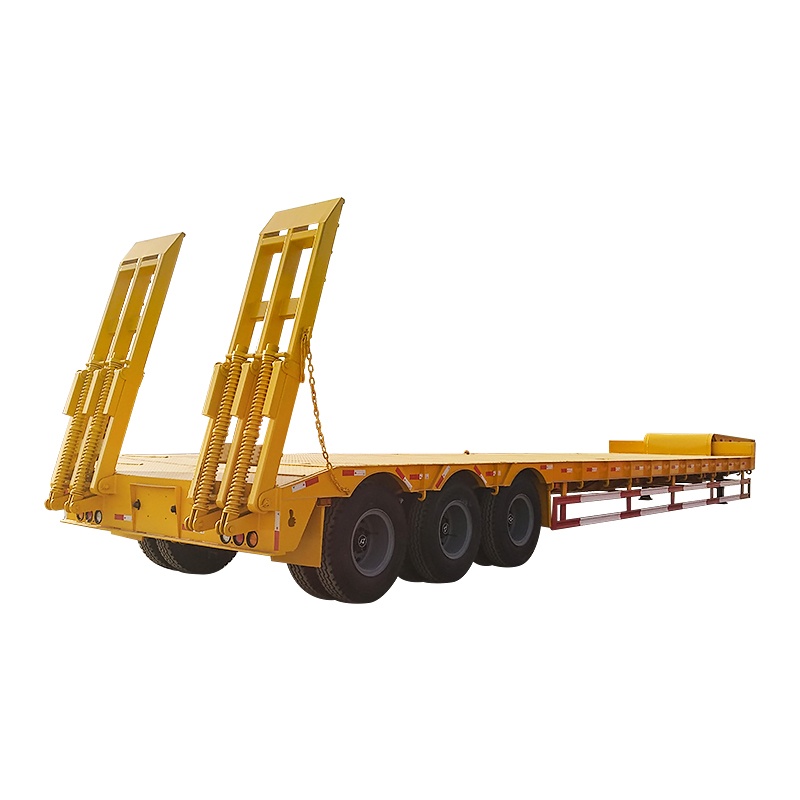
3. Structural Steel Specs: Resisting Center Deck Sag
Lowbed trailers carry concentrated mass directly across the center 4 to 6 meters of the well deck, creating massive bending moments:
| Structural Component | Chengda Heavy Haul Specification | Low-Grade Market Specification | Performance Advantage |
|---|---|---|---|
| Main Beam Steel Grade | Q550D or Q690 High-Tensile Alloy Plate (Yield Strength ≥ 690 MPa) | Standard Q345B Carbon Steel (Yield Strength 345 MPa) | Double the yield strength; prevents permanent sagging under 80T loads |
| Flange Dimensions | Upper Flange: 20 mm, Lower Flange: 22 mm, Web: 12 mm | Upper: 14 mm, Lower: 16 mm, Web: 8 mm | Resists extreme dynamic twisting when turning on unpaved mining haul roads |
| Deck Flooring | 4 mm - 5 mm diamond checkered steel plate + tropical hardwood friction strips | 3 mm smooth plate | High track friction prevents excavator steel tracks from sliding in wet conditions |
Frequently Asked Questions (FAQ)
Q: How does a hydraulic RGN trailer detach and re-attach?
A: The operator lowers the trailer front landing pads to the ground, uncouples the hydraulic safety pin locks, and uses the tractor's integrated hydraulic cylinders to push the gooseneck forward and detach it from the main deck. The tractor drives the gooseneck away, leaving the front of the deck resting flat on the ground for direct roll-on loading. After loading, the tractor backs up, re-engages the gooseneck hooks, and the hydraulic cylinders hoist the deck to travel height.
Q: What is the benefit of a lowbed trailer with side outriggers?
A: Heavy excavators (such as the CAT 349 or Komatsu PC400) have track widths exceeding 3.3 to 3.5 meters, which would hang dangerously off a standard 2.5-meter trailer. Heavy fold-out swing outriggers expand the deck width by 250 mm to 300 mm on each side (reaching 3.0 m to 3.2 m total width), providing solid support beneath wide machinery tracks.
Q: Can an RGN trailer be shipped via container?
A: No. Due to their overall length (13m–16m) and width (2.5m–3.0m), lowbed and RGN trailers are shipped via Break-Bulk (conventional cargo) with specialized lifting slings, or as rolling cargo on RORO vessels. Modular detachable goosenecks are often secured directly on the deck to save ocean freight cubic volume.
Recommended Lowbed & Lowboy Trailers
|
3 Axle Lowboy Trailer |
3 Axle Lowbed Semi Trailer |
Heavy Duty Brake Lining |