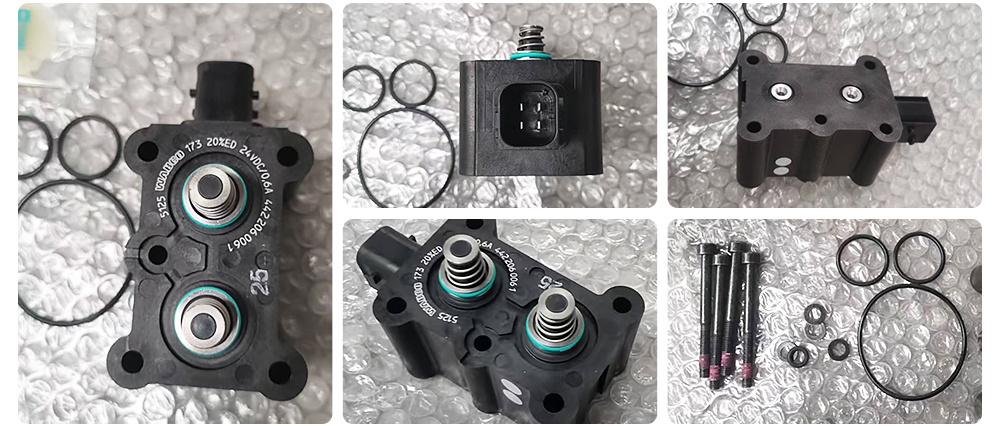
In heavy commercial pneumatic braking systems (Sinotruk Howo, Shacman, Foton, and multi-axle trailers), the four-circuit protection valve (multi-circuit protection valve, WABCO 934 714 series) acts as the central pneumatic traffic coordinator. Distributing clean compressed air from the air dryer into four independent reservoir circuits (front axle service, rear tandem service, parking/trailer emergency, and cab/auxiliary air), this valve ensures that a catastrophic air line rupture in one circuit cannot drain air from the remaining circuits, preserving emergency stopping capability at all times.
1. Technical Valve Port Numbering & Circuit Allocation Matrix
Standardized DIN ISO port numbering designations across commercial four-circuit valves:
| Port Designation | Pneumatic Function | Connected Reservoir Circuit | Standard Opening Pressure Threshold |
|---|---|---|---|
| Port 1 (Supply Inlet) | Primary compressed air supply | Fed directly from engine air compressor via air dryer | Full supply air pressure (up to 1.0 MPa / 145 psi) |
| Port 21 (Delivery Circuit 1) | Primary rear axle service brake circuit | Connected to rear axle service air tank (Tandem drive bogie) | Opens first at approx. 0.65 – 0.70 MPa (approx. 95 – 100 psi) |
| Port 22 (Delivery Circuit 2) | Primary front steer axle brake circuit | Connected to front steer axle service air tank | Opens second at approx. 0.65 – 0.70 MPa (approx. 95 – 100 psi) |
| Port 23 (Delivery Circuit 3) | Trailer supply & parking spring brakes | Feeds hand control valve, spring brake chambers, and red gladhand | Opens third at approx. 0.70 – 0.75 MPa (Safety priority) |
| Port 24 (Delivery Circuit 4) | Auxiliary pneumatic consumer circuit | Feeds air horn, air seat, cab suspension, and PTO shift cylinder | Opens last at approx. 0.72 – 0.75 MPa (Non-braking priority) |
2. The Cascade Charging Sequence: Why Service Brakes Fill First
Internal factory-calibrated spring poppets enforce a strict hierarchy during initial air charging:
- Brake Circuits First (Ports 21 & 22): When starting a truck with empty air tanks, compressed air pushes past internal pre-loaded valve discs, charging the front and rear service brake reservoirs first.
- Trailer & Parking Release Next (Port 23): Only after the primary service circuits reach 0.70 MPa does air bypass into Circuit 3, releasing the spring parking brakes and pressurizing the trailer emergency line. This mechanical safety interlock prevents a driver from releasing the parking brake and driving off before the service foot brakes have sufficient stopping pressure.
- Auxiliary Circuit Last (Port 24): Cab seat cushions and air horns only receive air after all braking circuits are 100% pressurized.

3. Circuit Failure Isolation Dynamics: Surviving a Severed Air Line
If an air hose on the front axle or trailer tears open on the highway:
- The Uncontrolled Leak Scenario: The severed line vents air to atmosphere, causing pressure in that specific circuit to drop to zero immediately.
- Internal Check Valve Sealing: The sudden pressure delta causes the internal spring of that failing circuit to slam its internal valve disc closed. Backflow from healthy circuits is mechanically blocked by one-way check valves.
- Retaining 0.50 MPa Holding Pressure: The four-circuit valve maintains a minimum retention pressure of 0.45 to 0.52 MPa (65 to 75 psi) in the remaining intact circuits, ensuring the driver retains full rear axle foundation braking and trailer emergency braking to stop safely on the highway shoulder.
4. Troubleshooting Common Four-Circuit Valve Malfunctions
| Observed Pneumatic Symptom | Most Probable Root Cause | Immediate Corrective Action |
|---|---|---|
| Air tanks charge to 0.6 MPa and stop; Circuit 3 or 4 never fills | Weak engine compressor output or cracked internal diaphragm/broken opening spring on Port 23/24 | Verify compressor builds 0.85 MPa; test individual port opening pressures; replace valve rebuild kit |
| Air leaks continuously from the valve exhaust breather flap | Internal rubber valve disc perforated by carbonized oil and desiccant grit from an unserviced air dryer | Disassemble valve; clean aluminum housing; replace internal valve seat discs and O-rings |
| Parking brakes refuse to release in cold desert/plateau mornings | Circuit 3 opening valve frozen shut by ice crystals formed from un-drained condensed water | Thaw valve housing with warm water (Never open flame!); drain air tanks; replace air dryer desiccant |
| Air horns or driver air seat fail to work while brakes operate normally | Port 24 opening valve blocked by dried lubricant sludge, or pressure-limiting valve misadjusted | Inspect Port 24 circuit check valve; verify system pressure reaches 0.75 MPa threshold |
Frequently Asked Questions
Q: Can the opening pressure of individual circuits be adjusted?
A: Yes. High-quality WABCO-style valves feature threaded hex adjusting plugs on the end caps. Turning a plug clockwise increases spring preload (raises opening pressure); turning counterclockwise lowers opening pressure. Calibrate only on a dedicated pneumatic test bench!
Q: What causes all air tanks to drain when the engine is turned off overnight?
A: While the four-circuit valve isolates circuits while driving, overnight air bleed-down is usually caused by leaking push-in fittings on nylon lines, leaking brake chamber diaphragms, or a failing compressor discharge check valve.
Q: Where can fleet operators source genuine WABCO four-circuit protection valves?
A: Browse our complete pneumatic inventory in the Heavy-Duty Spare Parts Category, inspect original Commercial Trucks, or consult our International FAQ Center.
Request Four-Circuit Protection Valve Quotation & Parts Catalog
Recommended Semi-Trailers
 3 Axle Flatbed Trailer |  3 Axle Lowboy Trailer |  3 Axle Container Chassis Trailer |