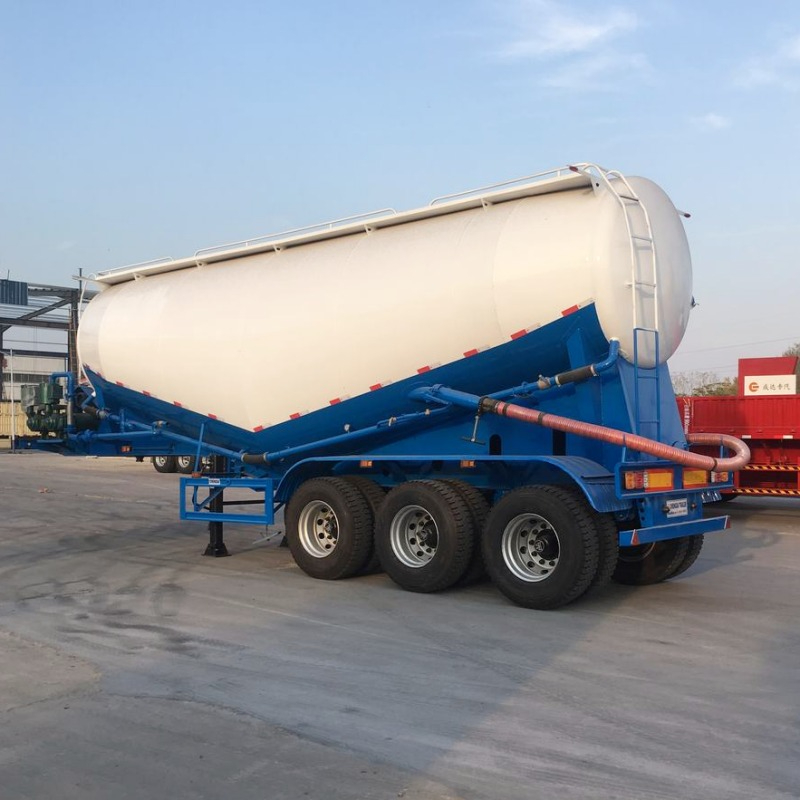
In commercial dry bulk powder logistics across Africa and the Middle East, a 45 CBM (cubic meter) V-shape or W-shape pneumatic bulk cement tanker semi-trailer discharges 40 to 50 tons of dry Portland cement or fly ash into 25-meter-high concrete batching silos in under 35 minutes. Operating in humid equatorial monsoons, diagnosing moisture-caked fluidized bed aeration fabric, clearing jammed 4-inch discharge butterfly valves, and balancing secondary blowing booster lines prevents prolonged unloading times (>90 minutes) and expensive cement residue accumulation exceeding 1,500 kilograms.

1. Technical Specification Comparison: Single-Compartment V-Shape vs. Dual-Compartment W-Shape
Aeration chute angles, fluidization surface areas, compressor requirements, and discharge residue limits:
| Engineering Parameter | Single-Cone V-Shape Cement Bulker (35 – 40 CBM) | Dual-Cone W-Shape Heavy Cement Bulker (45 – 50 CBM) |
|---|---|---|
| Internal Fluidized Bed Layout | Single continuous longitudinal bottom aeration trough | Dual independent V-troughs with separated air plenums |
| Fluidized Bed Slope Angle | Steep 14° to 16° slope angle toward central sump | Enhanced 16° to 18° steep slope angle (Resists powder hang-up) |
| Porous Aeration Media Material | Standard woven polyester canvas cloth (Multi-ply needle felt) | High-permeability synthetic air slide belt with silicone seal edge |
| Discharge Butterfly Valve Spec | 4-Inch (DN100) manual lever ductile iron butterfly valve | 4-Inch or 5-Inch (DN125) wear-resistant polyurethane-lined valve |
| Air Compressor Airflow Requirement | 10.0 m³ / minute @ 0.20 MPa continuous displacement | 12.0 m³ / minute high-flow twin-cylinder compressor (Wuhu / Suzhou) |
| Average Unloading Speed | approx. 1.2 to 1.4 Tons per minute | approx. 1.5 to 1.8 Tons per minute (Fast 25-minute cycle) |
| Factory Allowable Residue Rate | ≤ 0.4% of total payload (approx. 150 kg – 180 kg) | Strictly ≤ 0.25% to 0.30% (Under 100 kg total heel residue) |
| Target Construction Cargo | Standard Portland cement, lime powder, fly ash | Heavy bulk cement, ground blast furnace slag (GGBS), bentonite |

2. How the Fluidized Bed Works: Converting Powder into Liquid
Dry cement cannot flow through a pipe like water without dynamic pneumatic fluidization:
- The Fluidization Principle: Compressed air from the diesel-driven compressor enters the sealed plenum chambers beneath the porous canvas belts at 0.20 MPa (2.0 bar). Air micro-jets percolate upward through millions of microscopic pores in the canvas fabric, lifting and suspending individual cement dust particles.
- The "Liquid Cement" State: When aerated, the friction between cement grains drops to zero. The powder behaves like a turbulent liquid, flowing downward along the 16-degree fluidized bed slope toward the discharge outlet under gravity.
- The Secondary Blowing Booster Line: A secondary 2-inch bypass air pipe injects high-velocity compressed air directly into the discharge elbow behind the butterfly valve. This secondary jet creates a venturi suction effect that accelerates fluidized cement through the flexible rubber hose and shoots it up 25 meters into the storage silo.
3. Troubleshooting Slow Discharge & High Tanker Residue
Discharge times stretching past 60 minutes indicate fluidization and piping blockages:
| Observed Unloading Fault | Most Probable Root Cause | Immediate Corrective Action |
|---|---|---|
| Tank pressure builds to 0.2 MPa, but no cement flows from hose | Discharge butterfly valve disc jammed with hardened concrete; secondary booster valve closed | Tap butterfly valve body lightly; open secondary booster air valve; clear discharge elbow |
| Unloading time takes over 90 minutes; heavy cement residue (>1,000 kg) | Fluidized bed canvas blinded by moisture, creating hard crust; torn canvas blowing air hole | Open top manholes; inspect canvas for cement crusting; scrape or replace porous air slide belts |
| Air pressure fails to build past 0.12 MPa inside tanker shell | Top manhole lid rubber gasket torn; leaking pressure relief safety valve; compressor intake filter clogged | Replace manhole silicone gasket; adjust safety valve pop-off to 0.22 MPa; clean compressor air filter |
| Discharge hose jumps violently and plugs repeatedly | Tanker pressure dropped below 0.16 MPa (Insufficient velocity causing powder settlement in hose) | Close discharge butterfly valve; allow tank pressure to recover to 0.20 MPa; blow clear with booster |
4. Step-by-Step Fluidized Bed Canvas Replacement Protocol
Replacing moisture-hardened aeration canvas inside the confined tank shell:
- Confined Space Safety Entry: Ventilate the tanker with fresh air for 30 minutes. Wear protective dust respirators and safety goggles before descending through the top manhole with 24V explosion-proof inspection lamps.
- Unbolt Retaining Steel Slats: Use an impact driver to remove the countersunk stainless steel screws securing the flat clamp bars along both edges of the aeration trough.
- Remove Caked Old Fabric: Pull out the contaminated, stiffened canvas belt. Use a wire brush and scraper to remove hardened concrete nodules from the bottom perforated air support plate.
- Install New Multi-Ply Aeration Belt: Roll out the new genuine multi-ply woven polyester air slide fabric. Pull the fabric taut without wrinkles. Clamp the edges securely under the steel retaining bars, torquing screws evenly to 18 N·m to ensure an airtight perimeter seal.
Frequently Asked Questions
Q: What causes cement to cake into solid rock inside the fluidized bed?
A: Internal caking occurs when water enters through un-sealed top manholes during heavy tropical rainstorms, or when the air compressor discharges hot moisture without a condensate water separator.
Q: How do operators verify that the tanker is completely empty before leaving the silo?
A: When all cement has discharged, the tank pressure gauge needle will drop rapidly from 0.18 MPa down toward zero within seconds, accompanied by a hollow, whistling exhaust tone through the discharge hose.
Q: Where can cement logistics contractors procure certified bulk cement semi-trailers and parts?
A: Browse our complete powder transport lineup in the Semi-Trailers Category, view original Bulk Cement Semi-Trailers, or consult our International FAQ Center.
Request Bulk Cement Trailer Drawings & Spare Parts Quotation
Recommended Semi-Trailers
 3 Axle Bulk Cement Trailer |  2 Axle Cement Trailer |  3 Axle Flatbed Trailer |