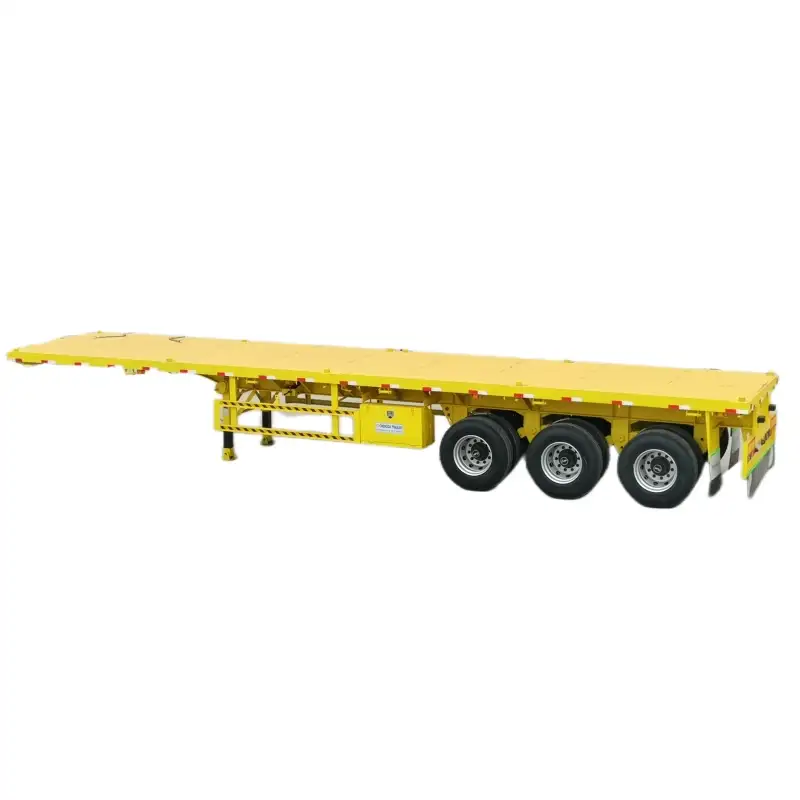
Flatbed semi trailers are the most versatile asset in a haulage fleet: they carry containers, steel sections, timber, palletised goods and over-dimensional freight with nothing more than a re-strap. For operators on African and Latin American corridors, the specification that matters is not the headline payload but how the deck, crossmembers and twist locks survive years of mixed loading.
1. Application & Duty Matching
Typical duty cycles for this range. Matching the structure and running gear to the actual cycle is what separates a trailer that lasts fifteen years from one that cracks in three:
- 40ft and 20ft container haulage
- Steel coil, section and plate transport
- Timber, pipe and over-length cargo
- Palletised and bagged general freight
2. Structure & Configuration
Core structure: Q345B or HG785 high-tensile main beams with a 2.5-3.0 mm chequered deck plate.
Configuration options: 12 or 13 locking positions for 20ft/40ft containers, side stanchion pockets, and optional front bulkhead.
3. Regional Axle-Load & Compliance
Axle spacing and tyre size are selected against the destination market's limits before steel is cut: SADC corridors at 56 t GCM, CEMAC at 50 t, ECOWAS at 51 t and the East African Community at 56 t. Each regime caps individual axle loads differently, so the same trailer may need a different bogie setting for a different corridor. We include the calculation with the quotation.
4. Shipping & Port Delivery
Standard export method: 40ft Flat Rack with the unit partially nested, or break-bulk for three or more units. Loading plans, lashing points and a stowage diagram are supplied with each shipment so the terminal can handle the unit without improvisation.
5. Ordering & Commissioning
Orders move through drawing approval, steel fabrication, painting and pre-shipment inspection. Each unit ships with an inspection report, a first-year consumable kit and a maintenance schedule in English or French. On arrival our engineers support commissioning by video call.
6. Sourcing FAQ
Q1: How do I confirm the right specification for my route?
A: Send us your legal axle-load limits, the cargo you carry most often and the typical road surface. We return a specification sheet with beam section, deck plate thickness, axle rating and body geometry matched to those inputs, together with a layout drawing for approval before production starts.
Q2: What is the production and delivery lead time?
A: Standard trailers are built in 20 to 30 working days; custom body work adds 5 to 10 days. Ocean transit to Lagos, Mombasa, Dar es Salaam, Douala or Abidjan usually takes 25 to 40 days, plus local clearance time.
Q3: What warranty and parts support comes with the unit?
A: Every unit ships with a 12-month or 50,000 km structural and component warranty, a first-year consumable kit, and a parts catalogue in English or French so your workshop can order by part number without waiting for translation.